Skill Development for Labour-Intensive Export Sectors: Samarth Scheme and Textile Competitiveness
What happened
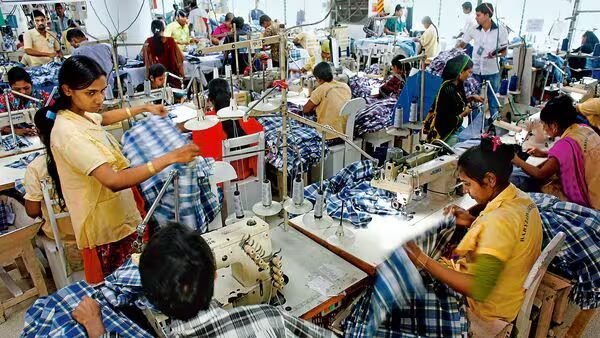
The government is considering a ₹25,000-crore, five-year skilling programme (Samarth 2.0) for the textiles and garments sector, up sharply from the ₹740 crore spent under Samarth 1.0 through March 2026. The Expenditure Finance Committee has examined the textiles ministry's proposal, which was announced in Budget 2026-27 and may soon go to the Cabinet. It aims to build industry-ready workers to support the target of $100 billion textile and garment exports by 2030.
Key takeaways
- Samarth (Scheme for Capacity Building in Textile Sector) is a demand-driven, placement-oriented skilling scheme run by the Ministry of Textiles with industry and academic partners — UPSC tests sector-specific skilling schemes as instruments of employment generation
- Textiles is the largest employer after agriculture, with about 45 million direct jobs and over 100 million livelihoods, mostly women and rural workers — links skilling to inclusive growth and female labour force participation
- The Expenditure Finance Committee appraises schemes above ₹500 crore before Cabinet or CCEA approval — a favourite polity-economy procedural fact
- Skilling is meant to exploit FTAs: India's 15 FTA partners offer a $198 billion textile market against current exports of only $11.5 billion to them — shows how trade policy needs supply-side capacity such as skilled labour
- Contemporary example: the proposed outlay is roughly 30 times Samarth 1.0 spending, signalling a shift to industry-linked, technology-aware training rather than counting trainees
Conceptual analysis
Labour-intensive manufacturing such as textiles and garments is central to India's strategy of absorbing surplus agricultural labour and generating formal jobs, as East Asian economies did earlier. However, India's competitiveness is limited by skill gaps, low productivity, fragmented small units and compliance with global buyer standards. Skilling schemes like Samarth, launched in 2017 under the broader Skill India framework, try to address this through training aligned to industry demand, with placement linkages and partnerships with industry bodies, state agencies and academic institutions. Samarth 2.0 proposes to modernise this framework by focusing on emerging technologies, automation, technical textiles and quality standards, with closer industry-academia collaboration. The fiscal scale-up reflects the government's aim to more than double exports to $100 billion by 2030 using FTAs with partners such as the UK, EFTA, UAE and Australia, which lower tariffs but need capacity and skilled labour to convert market access into actual exports. The approval process is instructive: the Expenditure Finance Committee, chaired by the Expenditure Secretary, appraises scheme design, costs and outcomes before Cabinet sanction. Challenges remain: training numbers do not equal employability, many trainees do not get placed or retained, and women's participation requires supportive infrastructure like hostels and safe transport. Outcome-based monitoring, certification, and industry co-design are therefore essential for the scheme to raise productivity and exports.
Concept explainers
An inter-ministerial body under the Finance Ministry's Department of Expenditure that appraises public expenditure proposals and schemes (generally above ₹500 crore) before approval by the Cabinet or competent authority.
Ministry of Textiles' demand-driven, placement-linked skilling scheme for the textile sector covering organised segments, spinning, weaving, and traditional sectors like handloom, handicrafts, sericulture and jute.
Production that uses relatively more labour than capital, such as garments, footwear and toys, and so generates large-scale employment.
A pact between countries to reduce or eliminate tariffs and other barriers on most trade between them, expanding market access for exporters.
The national umbrella framework (2015) for skilling, including PMKVY, NSDC and sector skill councils, aiming to train large numbers of youth in employable skills.
Syllabus tags
Source: Livemint, 19 Oct 2026
Read today's current affairs
Sign up free for daily UPSC concept cards, Prelims practice, and Mains evaluation.