Sample-Return Missions and Planetary Moon Science: JAXA's Martian Moons eXploration (MMX) to Phobos
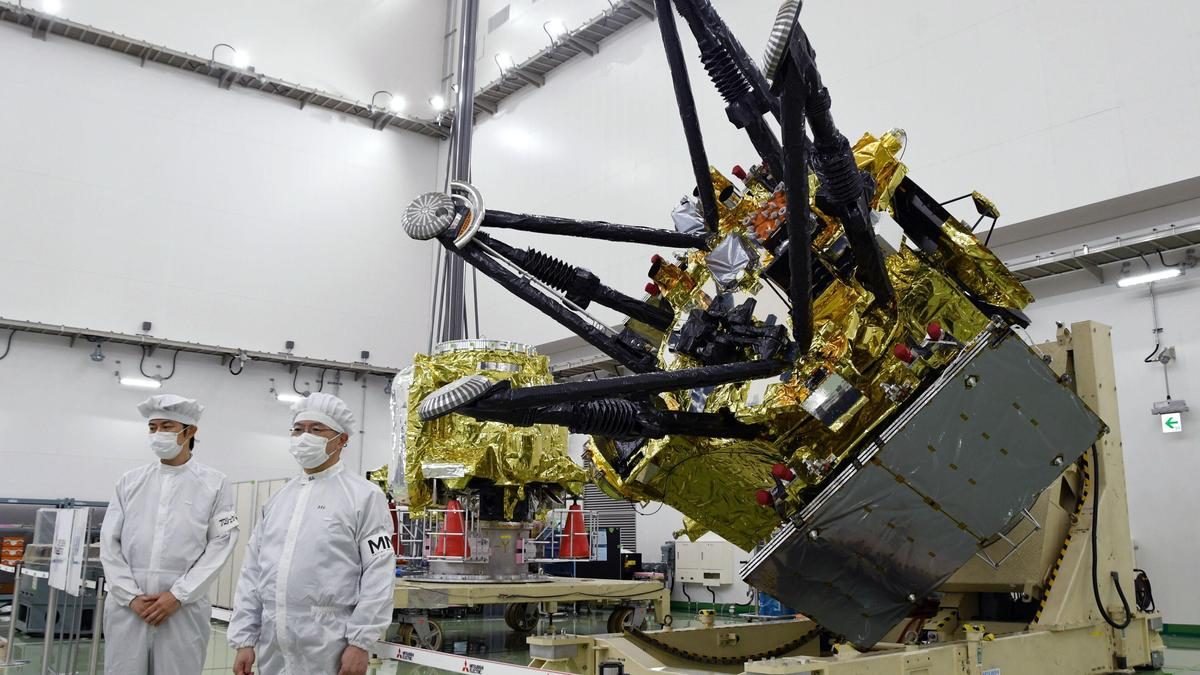
What happened
Japan's space agency JAXA is set to launch the Martian Moons eXploration (MMX) spacecraft on an H-3 rocket on 20 October 2026, on the world's first mission to bring back samples from Phobos. The spacecraft will reach the Mars region about a year after launch, study Phobos and fly by Deimos for around three years, and return to Earth in 2031. NASA and other agencies provide equipment and communications support.
Key takeaways
- Sample-return missions bring extraterrestrial material to Earth for lab analysis with far more precise instruments than in-situ probes — UPSC tests the distinction between flyby, orbiter, lander and sample-return missions
- MMX targets Phobos (about 20-30 km wide, orbiting Mars about 6,000 km away three times a day) to settle whether Mars' moons are impact debris or captured asteroids — a key theory-based question on solar system origins
- About 0.1% of the Phobos sample is expected to be Martian material, so the mission could give Mars information without a Mars landing — shows the scientific logic of choosing the nearer moon
- Phobos may serve as a staging base for future crewed Mars missions — links to the space exploration race among the US, China and others
- International collaboration (JAXA lead, NASA support) and the H-3 launcher show how space science partnerships and indigenous launch capacity work — relevant for India's Mangalyaan, Gaganyaan and the Phobos-related MMX-ISRO comparisons
Conceptual analysis
Sample-return missions are among the most demanding forms of planetary exploration. Unlike orbiters or landers that analyse material remotely or in situ, they carry material back to Earth, where large and sensitive laboratory instruments can study isotopes, minerals and organic compounds. Japan has experience with this through Hayabusa (Itokawa) and Hayabusa2 (Ryugu). MMX extends that heritage to the Martian system. Its central scientific question is the origin of Phobos and Deimos. One hypothesis is that they formed from debris after a giant impact on Mars; the other is that they are captured asteroids. Sample composition should discriminate between these, since a Mars-impact origin implies material akin to Mars crust, while a captured asteroid implies primitive, carbon-rich matter. Phobos was chosen because it is closer to Mars and may hold Martian ejecta, expected to be about 0.1% of the sample. The mission also has strategic value. Low-gravity moons could serve as staging points for human missions, and understanding their surface and resources reduces risk. Landing there is difficult, as Russia's failed Phobos attempts, including in 2011, show. For India, the mission is a benchmark for ISRO's own ambitions, such as Mangalyaan-2, Gaganyaan and possible future sample-return missions. It also illustrates how middle-power space agencies lead missions while sharing costs and capability with partners like NASA.
Concept explainers
A space mission that collects material from another celestial body and brings it to Earth for laboratory study.
The two small, irregular moons of Mars; Phobos is the larger and closer one, Deimos the smaller and more distant.
The idea that a large body struck Mars, ejecting debris that coalesced into moons.
The idea that the moons were asteroids from elsewhere that were gravitationally captured by Mars.
Japan's new flagship launch vehicle developed by JAXA and Mitsubishi Heavy Industries to be cost-effective and flexible.
Japan Aerospace Exploration Agency, Japan's national space agency.
Syllabus tags
Source: The Hindu, 18 Oct 2026
Read today's current affairs
Sign up free for daily UPSC concept cards, Prelims practice, and Mains evaluation.