Regulation of Illegal Sand Mining: Legal Framework, Enforcement Failures and the Role of the NGT
What happened
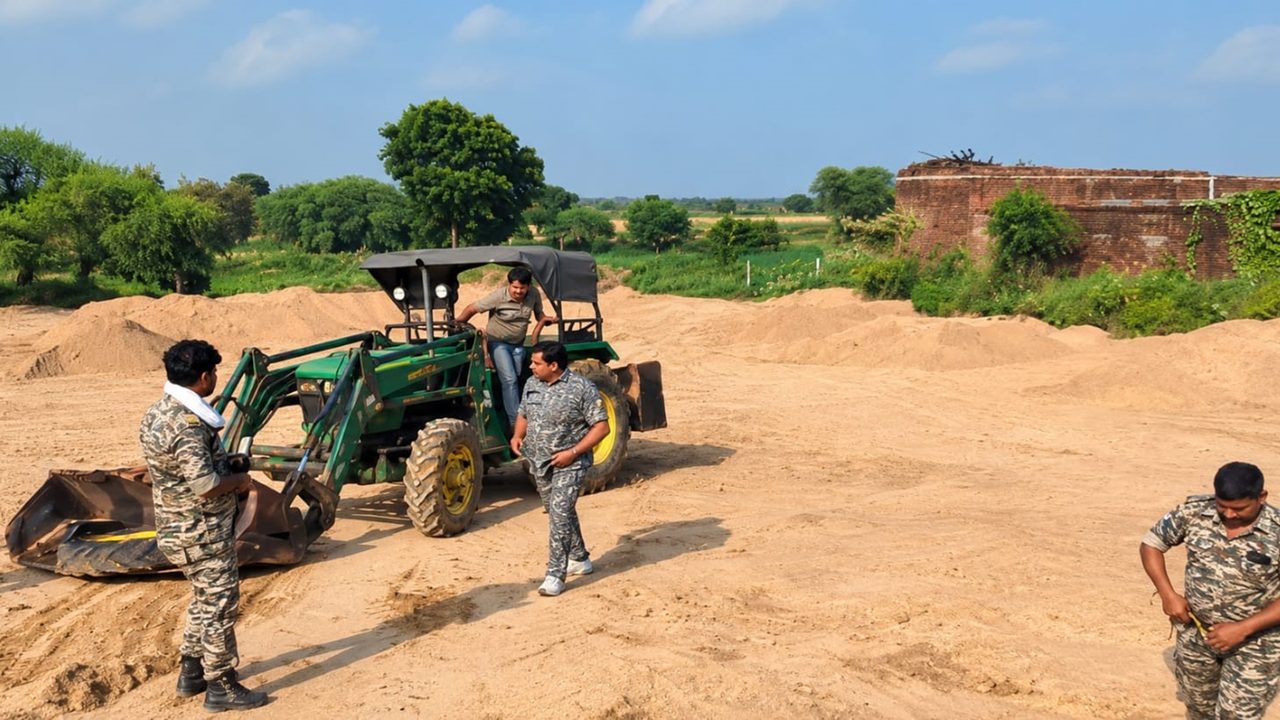
A joint committee of the CPCB, MP State Environment Impact Assessment Authority and MP Pollution Control Board, appointed by the NGT's Central Zone Bench, reported lapses in curbing illegal sand mining along the Sindh River in Bhind and Datia districts, Madhya Pradesh. It found 11 illegal storage yards holding about 6,010 cubic metres of sand, excavation in a restricted zone near a bridge, vehicles without number plates and no check-posts. It flagged selective enforcement and possible connivance of local officials with miners, and sought an inquiry fixing responsibility on the mining and police departments. This follows the Supreme Court's April warning to the state, which had promised a state-wide task force.
Key takeaways
- Sand is a 'minor mineral' under Section 3(e) of the MMDR Act 1957, so states regulate it through their own Minor Mineral Concession Rules — this explains uneven enforcement and why UPSC tests Centre-State roles in mining.
- Sustainable Sand Mining Management Guidelines 2016 and Enforcement & Monitoring Guidelines 2020 (MoEFCC) require district survey reports, replenishment studies, no-mining zones near bridges, and monsoon bans — the restricted-zone excavation near a Datia bridge is a direct violation.
- Environmental clearance for mining is granted by SEIAA under the EIA Notification 2006 — the SEIAA's presence on the committee shows the multi-agency regulatory structure.
- The NGT (NGT Act 2010, Article 21 linkage) can order inquiries through joint committees and fix accountability — an example of 'environmental governance through expert-judicial bodies'.
- Illegal mining harms riverine ecology: bed lowering, bank erosion, groundwater depletion and threats to species like the gharial in the Chambal sanctuary region; the Supreme Court warned of a mining ban and paramilitary deployment, and the state task force was found ineffective on the ground.
Conceptual analysis
Sand is a vital construction input, and rising urbanisation and infrastructure demand have created a lucrative illegal market, often called the 'sand mafia'. Legally, sand is a minor mineral under the MMDR Act 1957, which gives state governments the power to frame rules, grant leases and prevent illegal mining. The Centre influences practice through MoEFCC's Sustainable Sand Mining Management Guidelines (2016) and the Enforcement and Monitoring Guidelines (2020), which stress district survey reports, replenishment-based extraction limits, drone and GPS-based monitoring, and bans near bridges and during monsoon. Environmental clearance is processed by SEIAA/DEIAA under the EIA Notification 2006, and the Supreme Court (Deepak Kumar, 2012) required clearance even for small leases. Ecologically, indiscriminate extraction lowers river beds, undermines bridge foundations, depletes aquifers, destroys habitats of species such as gharials, turtles and Gangetic dolphins, and alters flood patterns. The Madhya Pradesh case shows the gap between law and implementation: a task force exists on paper but lacks check-posts, vehicle tracking and impartial action, and officials may collude with miners. The NGT, with judicial and expert members, uses joint committees to investigate and recommend accountability, while the Supreme Court has threatened drastic measures. Solutions include transparent e-auctions, end-to-end e-transit passes, satellite monitoring, promoting manufactured sand (M-sand) and recycled aggregate, community vigilance, and stronger penalties and protection for whistleblowers and enforcement officers.
Concept explainers
Defined in Section 3(e) of the MMDR Act 1957 (e.g., sand, building stone, gravel); regulated primarily by states.
Specialised body under the NGT Act 2010 for speedy disposal of environmental cases, with judicial and expert members.
State Environment Impact Assessment Authority; grants environmental clearance for category B projects including many mining leases.
Assessment of how much sediment a river naturally deposits, used to set sustainable extraction limits.
A state-level multi-department enforcement body formed to prevent illegal excavation, transport and storage of sand.
Manufactured sand made by crushing rock, an alternative to river sand.
Syllabus tags
Source: Indian Express, 19 Oct 2026
Read today's current affairs
Sign up free for daily UPSC concept cards, Prelims practice, and Mains evaluation.