Preferential Tariff Concessions under FTAs: Tariff Lines, Tariff-Rate Quotas and Rules of Origin
What happened
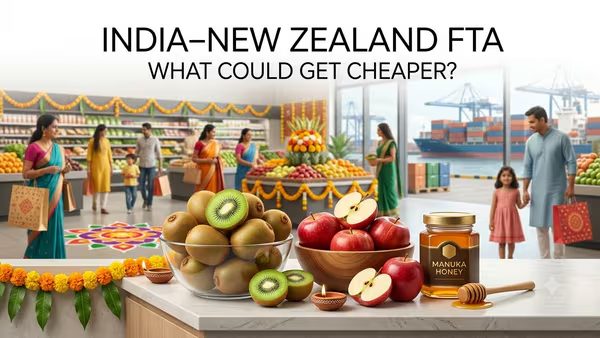
On 16 October, the Finance Ministry's Department of Revenue notified the first set of customs duty concessions under the India-New Zealand FTA, issued under Section 25(1) of the Customs Act, 1962. From 20 October, fresh, chilled and frozen sheep meat will attract zero basic customs duty, AIDC and health cess. Eligible kiwi fruit valued at $2.50/kg or more will attract 15% BCD, and certain fish products 25.71% BCD. Wine and manuka honey also get concessions, while dairy and key agricultural items stay excluded.
Key takeaways
- FTAs are implemented domestically through customs notifications under Section 25(1) of the Customs Act, 1962, which empowers the Centre to exempt goods from duty in the public interest — this explains how a treaty becomes enforceable tariff law.
- Concessions are tariff-line specific, not blanket: sheep meat gets zero BCD, AIDC and health cess, while fish lines attract 25.71% BCD — UPSC tests the idea of negotiated schedules with differentiated tariff cuts.
- Tariff-rate quotas (TRQs) allow a fixed quantity to enter at preferential rates, with higher duty beyond the quota — a calibrated tool to protect domestic producers while opening access.
- Kiwi fruit concession applies only at a minimum import price of $2.50/kg — a price-linked condition guarding against undervaluation and market flooding of domestic apples/fruit growers.
- Sensitive sectors (dairy, key agricultural items) are excluded and importers must prove New Zealand origin — shows negative lists and rules of origin as safeguards against trade deflection and farmer livelihood risks.
Conceptual analysis
A Free Trade Agreement is a treaty in which partners reduce or eliminate tariffs on a substantial share of mutual trade. Signing is only the first step. Tariff cuts have legal force in India only when the Finance Ministry notifies the preferential rates, using Section 25(1) of the Customs Act, 1962. The India-New Zealand notification shows how this works. Concessions are attached to specific tariff lines, so the rate depends on how a product is classified under the Customs Tariff. Some goods, such as sheep meat, get zero BCD, AIDC and health cess. Others, such as fish, get reduced but still substantial duty. Protective design features recur in Indian FTAs. TRQs cap the volume that enters at lower rates. Minimum import prices, as with kiwi fruit, prevent price undercutting. Exclusion lists shield politically and economically sensitive sectors like dairy and staple agriculture, where small farmers dominate. Rules of origin, proved through origin certificates, ensure only genuine New Zealand goods benefit and block routing through third countries. Economically, such agreements aim to diversify import sources, lower input costs and secure market access for Indian exports. They also carry risks: competition for domestic producers, revenue loss and a widening trade deficit if imports outpace exports. The staged, conditional rollout shows India balancing trade liberalisation with farmer protection and fiscal considerations.
Concept explainers
The core import duty levied under the Customs Act and Customs Tariff Act on goods entering India.
A quantity limit on imports at a preferential or lower duty rate; imports above the quota face a higher rate.
Criteria that determine the country where a product is deemed to be made, so that only eligible goods get FTA benefits.
Agriculture Infrastructure and Development Cess, a cess levied on certain imports to fund agricultural infrastructure.
Empowers the Central Government to exempt goods from customs duty wholly or partly, by notification, in public interest.
A specific product category in the tariff schedule at which a duty rate is applied.
Syllabus tags
Source: Livemint, 17 Oct 2026
Read today's current affairs
Sign up free for daily UPSC concept cards, Prelims practice, and Mains evaluation.