Influence of RSS on Education Policy in India
What happened
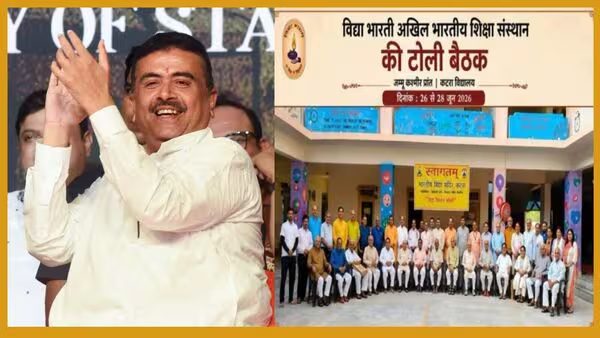
West Bengal Chief Minister Suvendu Adhikari announced plans to establish at least 1,000 schools run by the RSS's education wing, Vidya Bharati, across the state within a year. This announcement was made during an event marking the 74th anniversary of Vidya Bharati, where Adhikari emphasized the need for 'nationalistic learning' and suggested merging the state's education departments into one.
Key takeaways
- RSS's Vidya Bharati operates over 12,000 schools nationwide — [This reflects the significant influence of the RSS in shaping educational policies and curricula in India.]
- The vision of Vidya Bharati emphasizes Hindutva and nationalistic education — [This indicates a shift in educational focus towards ideological teachings aligned with the ruling party's philosophy.]
- Adhikari's call for merging education departments suggests a centralized approach to education — [This raises questions about the autonomy of educational institutions and the potential for politicization of education.]
- The emphasis on 'nationalistic learning' reflects broader trends in Indian education policy under the current government — [This is relevant for understanding the ideological underpinnings of educational reforms in contemporary India.]
- Adhikari's remarks on previous governments 'polluting' education highlight ongoing political tensions regarding educational content — [This illustrates the contentious nature of educational discourse in India, particularly between different political ideologies.]
Conceptual analysis
The influence of the Rashtriya Swayamsevak Sangh (RSS) on India's education policy has been a topic of significant discussion, particularly with the recent announcement by West Bengal Chief Minister Suvendu Adhikari to establish 1,000 schools under the RSS's Vidya Bharati. This initiative aims to promote a curriculum centered around Hindutva and nationalistic values, reflecting the ideological stance of the ruling Bharatiya Janata Party (BJP). Vidya Bharati, which already operates a vast network of schools across the country, seeks to instill a sense of patriotism and cultural identity among students. Adhikari's proposal to merge the state's education departments into a single entity further indicates a move towards centralized control over educational governance, potentially limiting the diversity of educational approaches and content. This shift raises concerns about the politicization of education and the implications for academic freedom, as the government seeks to align educational institutions with its ideological framework. The ongoing discourse around education in India thus highlights the intersection of politics, ideology, and governance, making it a critical area of study for understanding contemporary Indian society.
Concept explainers
Rashtriya Swayamsevak Sangh, a Hindu nationalist volunteer organization in India.
An education wing of the RSS that runs a network of schools across India.
An ideology advocating for the promotion of Hindu values and culture.
Education that emphasizes patriotism and national identity.
A system where educational policies and administration are controlled by a central authority.
Syllabus tags
Source: Livemint, 04 Sep 2026
Read today's current affairs
Sign up free for daily UPSC concept cards, Prelims practice, and Mains evaluation.